
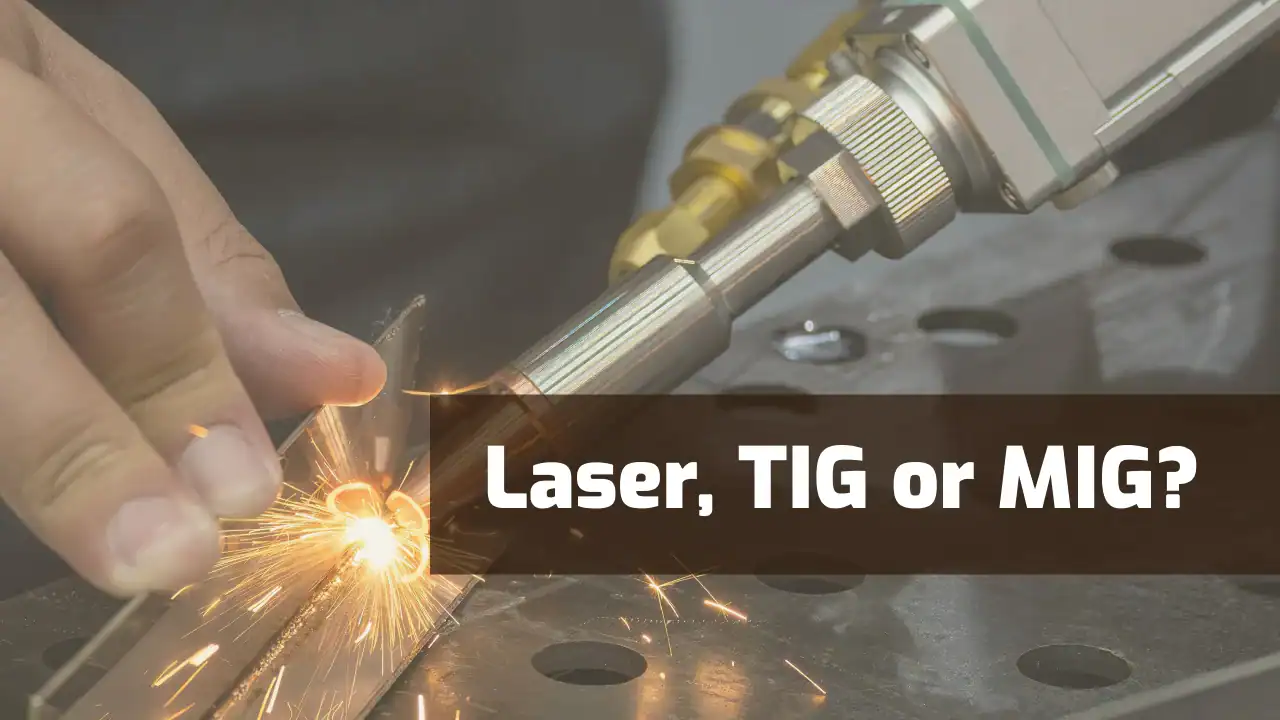
Choosing between laser, TIG, and MIG welding isn’t about finding the “best” process, it’s about matching the process to the job.
A laser welder that excels at thin stainless production can be a poor investment for structural fabrication, while MIG can lay down metres of weld in the time it takes TIG to complete a single joint.
Each process has strengths, limitations, and ideal applications.
The right choice depends on the material, thickness, production volume, weld appearance, and budget. This guide compares where laser, TIG, and MIG welding perform best, where they struggle, and how to decide which process suits the work in front of you.
Quick Overview
| Process | Best For | Main Limitation |
|---|---|---|
| Laser | Thin sheet metal, precision manufacturing, high-volume production | High equipment cost and tight fit-up requirements |
| TIG | Aluminium, stainless steel, cosmetic welds, precision fabrication | Slow and requires greater operator skill |
| MIG | Structural steel, fabrication, repair work and production welding | More spatter and less refined weld appearance |
How the Three Processes Really Differ
Although all three processes join metal, they do it in very different ways.
Laser welding concentrates energy into a very small area, producing deep penetration with a small heat-affected zone (HAZ). Because less surrounding metal is heated, there’s typically less distortion, warping, and post-weld finishing than with conventional arc welding. This makes laser welding particularly well suited to thin sheet metal and precision manufacturing.
TIG welding gives the welder complete control over the weld puddle. It produces exceptionally clean welds on stainless steel, aluminium, and thinner materials, making it the preferred choice for fabrication where appearance and precision matter more than speed.
MIG welding is designed for productivity. Wire is fed continuously through the torch, allowing long welds to be completed quickly with good penetration. That’s why it’s still the process most fabrication shops rely on for structural work.
Which Process I’d Choose for Common Jobs
Thin Stainless Steel (0.5–3 mm)
Verdict: TIG for small projects, laser for production.
TIG is still my first choice for one-off fabrication, repairs, and custom stainless work. It offers excellent control, handles slight variations in fit-up, and doesn’t require the investment or production volume needed to justify laser equipment.
Laser welding becomes the better option when you’re manufacturing the same parts repeatedly. Its low heat input, small heat-affected zone, and high travel speeds make it ideal for thin stainless components where consistency and throughput matter.
The trade-off is that laser welding demands much tighter joint fit-up and a significantly higher equipment investment.
MIG can weld thin stainless, but it’s generally less forgiving and increases the risk of burn-through and excess cleanup.
Read more: TIG Welding Stainless Steel for Beginners
Aluminium Fabrication
Verdict: TIG would still be my first choice for most aluminium work.
Aluminium demands excellent heat control, and TIG allows the welder to carefully manage the puddle while producing clean, attractive welds on components such as motorcycle parts, pipework, frames, and marine fabrication.
Laser welding can produce excellent aluminium welds in controlled manufacturing environments, but it demands accurate joint preparation and significantly higher equipment costs.
MIG becomes the better option once sections become thicker and productivity outweighs appearance.
Structural Steel Fabrication
Verdict: MIG remains the practical choice for most fabrication shops.
Structural steel fabrication is usually about productivity rather than producing perfect-looking welds. Fabricators need good penetration, consistent deposition rates, and the ability to weld long joints efficiently.
While TIG can certainly produce high-quality structural welds, it’s rarely economical for larger fabrication jobs.
Laser welding is used in some automated industrial applications, but for general workshop fabrication, MIG remains the standard process.
Cosmetic or Visible Welds
Verdict: TIG for custom fabrication, laser for repeat production.
When the finished weld will remain visible, appearance matters just as much as strength.
TIG welding is my choice for one-off fabrication, architectural metalwork, motorcycle parts, and other projects where control and weld appearance are the priority. A skilled welder can produce clean, consistent beads with minimal finishing.
Laser welding is better suited to high-volume production. Its concentrated heat input creates a small heat-affected zone (HAZ), reducing distortion and post-weld cleanup while delivering consistent results across repeated parts.
For bespoke work, I’d choose TIG. For manufacturing hundreds of identical components, laser has the advantage.
Site Repairs and Maintenance
Verdict: I’d choose MIG almost every time.
Real-world repair work rarely involves perfectly prepared material. Paint, mill scale, rust, awkward positions, and imperfect joint fit-up are common.
MIG is generally more tolerant of these conditions than TIG or laser welding, making it the most practical process for maintenance, agricultural equipment, structural repairs, and general fabrication work.
Cost Matters More Than Most People Think
Before deciding that laser welding is the right solution, it’s worth considering the equipment investment.
Modern handheld laser welders have become much more affordable than early industrial systems, but they’re still considerably more expensive than comparable TIG or MIG equipment.
If you’re comparing budgets, this guide explains the cost of a laser welding machine in more detail.
For many fabrication shops, the additional productivity only justifies the investment when there’s enough repeat production to offset the higher purchase price.
Advantages & Limitations
| Process | Biggest Advantage | Biggest Drawback |
|---|---|---|
| Laser | Fast, precise, minimal distortion | Expensive and requires excellent joint fit-up |
| TIG | Outstanding control and weld quality | Slow and operator-dependent |
| MIG | Fast, versatile and productive | More spatter and less refined appearance |
Common Mistakes When Choosing a Welding Process
One of the biggest misconceptions is assuming that laser welding automatically replaces TIG or MIG because it’s newer technology.
In reality, every process still has situations where it performs best.
Other common mistakes include:
- Choosing TIG for high-volume production where productivity matters most.
- Using MIG when cosmetic weld appearance is the priority.
- Investing in laser equipment without considering fit-up tolerances or production volume.
- Selecting a process based on the machine rather than the material, joint design, and application.
Final Verdict
There isn’t a single welding process that’s best for every application.
If precision, minimal distortion, and production speed are your priorities, laser welding offers clear advantages in the right environment.
For manual precision work on stainless steel and aluminium, TIG remains difficult to beat. When productivity, versatility, and structural fabrication are the goal, MIG continues to be the process most workshops rely on.
The best results come from choosing the process that matches the job—not simply the newest or most advanced machine.