
Welding is not always the right answer, and neither is bolting.
The choice between the two is an engineering call, not a preference call — and if you can’t explain why you chose one over the other, you’ll lose that argument the first time an inspector or customer asks.
This guide gives you the reasoning behind the choice, not just the rule of thumb.
When welding wins
A welded joint is, in the simplest terms, a metallurgical union: the parent metal and the filler fuse into one continuous piece. That gives a welded connection some genuine advantages over a bolted one.
Strength-to-weight is the obvious one. A properly executed groove weld on structural steel can develop the full strength of the base metal, which means you can engineer a lighter assembly than a bolted equivalent.
Welds also seal joints, which matters anywhere fluids, gases, or contaminants are in play — pressure vessels, tanks, exhaust systems, hydraulic manifolds.
Stiffness matters too. Bolted joints have small but real slip movements under load. Welds don’t. If you’re building something where dimensional stability matters under cyclic load — machine frames, jigs, certain trailer and chassis applications — welding gives you a stiffer assembly.
And then there’s geometry. Some joints simply cannot be reached with a fastener: tight corners, blind backsides, complex intersecting tubes. That’s weld-only territory.
The trade-offs are real. Welds are essentially permanent. The joint introduces a heat-affected zone (HAZ) that can change the parent metal’s properties around the bead.
And qualifications matter, for structural work in the US, the welder, procedure, and inspection have to meet AWS D1.1 / D1.1M Structural Welding Code – Steel or the appropriate sister code. That requirement is the reason an engineer can sign off on a welded structure with confidence.
When bolting wins
A welder who knows when not to weld is more valuable than one who reaches for the torch every time. Bolting wins when any of the following are true:
- The assembly has to come apart again. Inspection, maintenance, transport, future modification — if the joint will be disassembled, bolt it.
- Field assembly under uncontrolled conditions. Wind, rain, dust, no shore power, no preheat capability. Site bolting beats field welding for quality control in nearly any weather condition.
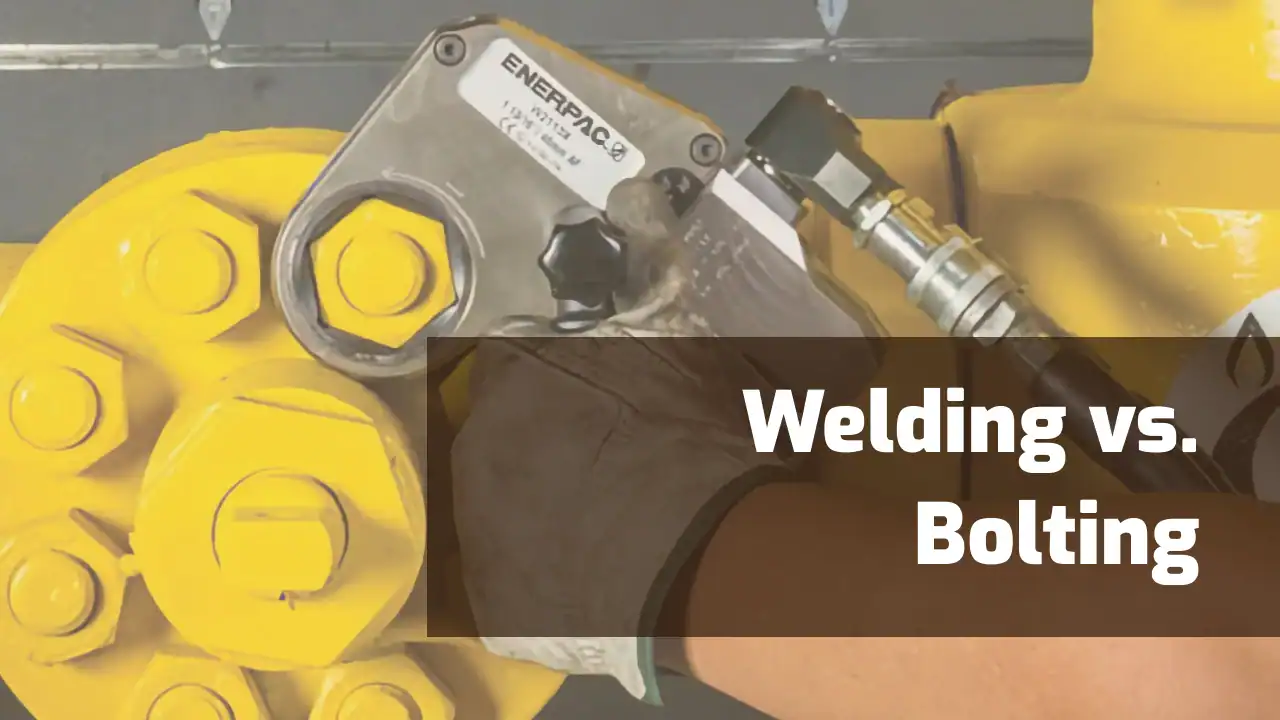
- The joint sees high cyclic or shock loading and needs verifiable preload. Wind turbine flanges, pressure-vessel bolted closures, large flange connections in oil and gas — these depend on controlled bolt preload that you can measure and re-verify. This is where bolting becomes a precision discipline. Controlled-tightening tools like Atlas Copco ITBA hydraulic torque wrenches, bolt tensioners, and traceability software exist for exactly this reason: eyeballing torque on a critical joint isn’t acceptable in wind energy, oil and gas, or heavy industrial construction anymore.
- Dissimilar metals that don’t weld well together. Bolting sidesteps galvanic and metallurgical headaches that would otherwise force you into specialty processes.
- Field repairs where heat is a hazard. Tank farms, refineries, fuel-system components — anywhere a hot-work permit is a problem.
The trade-offs go the other way. Bolted joints add weight, the holes themselves can become fatigue origins, and a bolted connection is only as good as its preload, which means inspection regimes and, for critical jobs, calibrated tooling.
Where each shows up in real fab work
The table below maps common fabrication and structural scenarios to the joint type that typically wins, and why.
These aren’t hard rules — engineering judgment always applies — but they reflect what you’ll see specified on most US drawings.
| Application | Typical choice | Why |
|---|---|---|
| Steel building frame columns/beams | Welded shop, bolted field | Welding is faster and more controllable in the shop; bolting allows site assembly and is governed by RCSC spec |
| Pressure vessels (ASME Section VIII) | Welded | Code requires welded construction for the shell; bolted closures only where access is needed |
| Wind turbine tower flange connections | Bolted with controlled preload | Disassembly access, fatigue loading, verifiable tensioning |
| Trailer chassis and frames | Welded | Stiffness, weight, geometry |
| Pipe flanges in process plants | Bolted | Gasket compression must be measurable and re-establishable |
| Machine guards and access panels | Bolted | Removal for maintenance |
| Aluminum boat hulls | Welded | Sealing and weight |
| Large agricultural equipment frames | Welded with bolted sub-assemblies | Hybrid approach is normal |
| Bridge gusset plates (new construction) | Bolted (high-strength) | Slip-critical connections specified by AISC/RCSC |
| Custom shop fixtures | Welded | Dimensional stability under load |
You’ll notice the answer is often “both, in different places on the same structure.” A modern steel building uses welds in the shop and bolts in the field.
A wind turbine has welded tower segments and bolted flange joints. Knowing which goes where is more useful than picking a side.
The decision framework that holds up under questioning
When a customer, inspector, or boss asks why you chose what you chose, you want a defensible answer in four parts: load type and direction, service environment, disassembly requirements, and inspection or code requirements.
Run a job through those four questions and the joint type usually picks itself. Welded for permanent, sealed, stiff, or hard-to-reach. Bolted for serviceable, dissimilar, weather-exposed, or preload-critical.The welders who get hired back are the ones who understand both sides of this.
If you want to dig deeper into reading drawings and understanding what an engineer is actually asking for, our piece on welding symbols is the cleanest reference for the symbol language you’ll see on those prints.
Combine that with the decision framework above and you’ll be able to look at a drawing, see why the engineer specified what they did, and — when it matters — push back with a better idea.